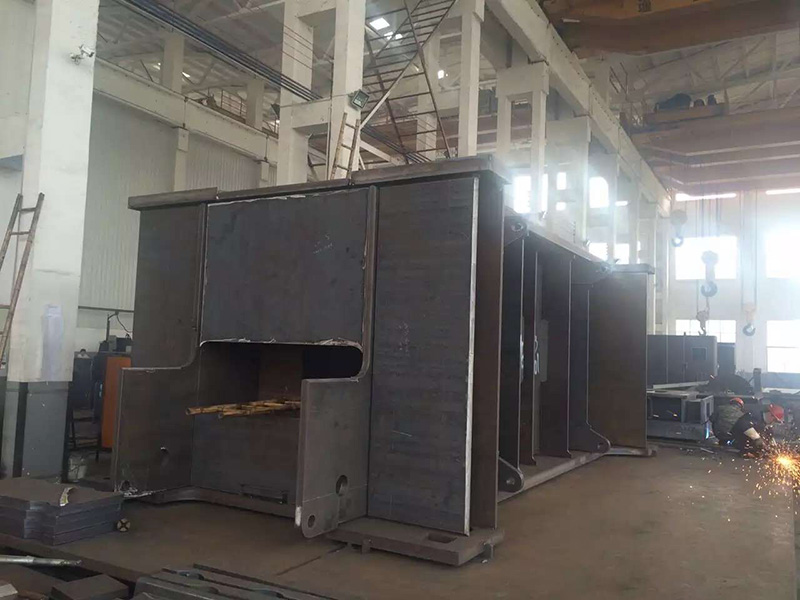
Buying large scale machining is not the same as buying ordinary CNC work. A 40-tonne welded frame and a 200mm bracket are both "CNC machined", but only one of them can be ruined by a forklift, a hot afternoon, or a clamp placed 3 metres from the cutting edge.
This article sets out the four things a heavy machining supplier actually has to demonstrate — envelope, load capacity, thermal behaviour and metrology — using the equipment and process data of Changzhou Yuqing Heavy Industry Machinery Co., Ltd. (Yuqing Heavy Machinery), a heavy machining and fabrication plant in Xueyanqiao Town, Wujin District, Changzhou, Jiangsu, China.
Where "Large" Starts
The Three Limits That Define a Large Job
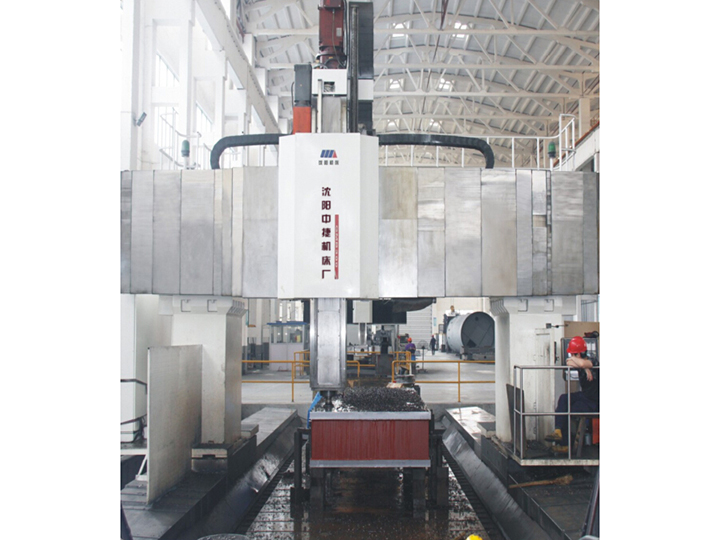
CNC Gantry Milling Boring Machine for Large-Scale Machining
There is no industry-wide threshold, but in practice a job becomes
large-scale when it breaks one of three limits: it does not fit a standard machining centre, it cannot be repositioned by hand, or its own weight distorts it during cutting.
Signs you are in that territory:
• The part exceeds roughly 2m in any axis, or needs a gantry machine to reach the top face
• Weight is measured in tonnes, not kilograms
• The drawing specifies a bore diameter above 200mm or a deep hole longer than 1m
• Datum features sit on two faces that cannot both be reached in one setup on a small machine
Once a job crosses those lines, the shop's machine list matters more than its hourly rate.
Envelope: The Number That Rules Everything
The first question a serious supplier will ask is not "what material?" but "what are the maximum dimensions?"
Yuqing's largest machine is a Jinan Second Machine Tool gantry machining centre with a 6000 × 13000mm table and 3000mm of height. That envelope covers large boxes, heavy frames, wind turbine flanges and pressure vessel end caps. The bed and column are HT300 integral castings given two rounds of ageing treatment to remove internal stress, which is what keeps a 13-metre machine from drifting over a long cut.
Alongside it, the shop runs floor-type milling and boring machines in Φ160 and Φ200 spindle sizes, a Kunming TJK6920A floor-type machine, a Shenyang Zhongjie gantry boring and milling centre, a Suzhou Neway PM254 gantry centre, and a 5-metre vertical lathe for rotational parts.
|
Machine |
Type |
Typical work |
|
Gantry centre, 6000 × 13000 × 3000mm |
Fixed-beam gantry |
Large boxes, frames, flanges, vessel heads |
|
Φ160 floor-type milling and boring |
Floor type |
Bores 20–500mm, deep holes to 2000mm |
|
Φ200 floor-type milling and boring |
Floor type |
Heavier bores, long-stroke machining |
|
Gantry boring and milling centre |
Gantry |
Multi-face boring and milling |
|
5-metre vertical lathe |
Vertical turning |
Large rings, discs, housings |
Load Capacity and Workholding
A large machine is only useful if the part can be held safely and rigidly. The Φ160 floor-type machine at Yuqing carries a standard 2000 × 2500mm table rated to 30 tonnes, with a 3000 × 4000mm table available as an option.
Workholding on oversized parts is where a lot of suppliers quietly fail. Thin-wall weldments deflect under clamping force; castings with irregular surfaces only touch the table at three points; parts with no flat face need fabricated fixtures rather than standard clamps. Good practice is to plan the fixture while the drawing is still being reviewed, not after the first cut.
Thermal Behaviour Across a Large Envelope
Why a Warm Afternoon Changes the Bore
Accuracy on a small part is a function of the machine. Accuracy on a large part is a function of the machine plus the environment plus the part itself.
Three effects dominate:
• Mechanical deflection — the further the spindle or ram extends, the more it sags under its own weight and cutting load
• Thermal expansion — a 6-metre steel part grows roughly 0.07mm for every 1°C rise; a warm workshop in July can shift a bore by more than the drawing tolerance
• Backlash and wear — magnified over long travels
Suppliers counter these with thermal growth compensation, backlash compensation and 3D volumetric compensation, all of which have to be set up per machine rather than bought off a shelf. On the Yuqing machines the feed axes use pre-stretched ball screws and plastic-coated linear guides with servo motors coupled directly to remove transmission gaps.
Practical numbers from the Φ160 floor-type machine show what a properly set-up heavy machine can hold: positioning accuracy ±0.015mm per 1000mm, repeat positioning ±0.008mm, and boring roundness of 0.005mm or better. The spindle runs with radial runout under 0.003mm after a carburising, quenching and precision grinding sequence, on imported roller bearings assembled by constant-temperature cold fitting.
Metrology: Proving It After the Cut
Measuring at the Machine
On large parts you cannot move the workpiece to the inspection room, so inspection has to come to the workpiece. In-process measurement integrated with the CNC control is the standard approach, backed by 2D and 3D laser measurement systems and coordinate measuring machines for final verification.
That matters commercially. Rework on a 20-tonne fabrication is expensive and slow; catching a 0.1mm deviation before the finishing pass is cheap.
Every Yuqing machine completes 72 hours of no-load running, a full-stroke positioning accuracy test and a trial cut before dispatch, with an assembly inspection report and accuracy calibration report supplied with the machine.
Materials and Finishing
Heavy machining at Yuqing covers Q235 carbon steel, 45# steel, stainless steel, cast iron and alloy steel. Milling capacity is quoted at roughly 30% higher than a conventional boring machine on comparable work, which comes from the combination of gantry rigidity and a 37/45kW spindle motor on the floor-type machines.
After machining, parts move into the shop's own post-processing chain — deburring, surface grinding, polishing, and coating options such as painting or hot-dip galvanising — plus UT/MT/RT non-destructive testing where the drawing calls for it.
Questions to Put in Your RFQ
If you are sourcing large scale machining, ask for these five things and compare the answers:
1. Maximum part dimensions and weight your supplier can hold, stated in writing
2. Which machine will actually run the job, and its positioning accuracy over full stroke
3. How thermal compensation is handled and whether the shop is climate-controlled
4. In-process measurement method, and what report you will receive
5. Lifting and rigging capacity at the shop, and how the part is protected in transit
About Yuqing Heavy Machinery
Changzhou Yuqing Heavy Industry Machinery Co., Ltd. has been machining and casting since 1989, and now runs a 10,000m² plant with a team of more than 70 and over 30 pieces of production equipment. The company holds ISO certification and was recognised as a national high-tech enterprise in 2025. Its integrated capability covers machining, welding and casting, so a large welded structure can be fabricated and then machined without changing supplier.
Send drawings and a target tolerance to sales@czyqzg.com or call +86 13906152937, and the engineering team will confirm whether the job fits the envelope and which machine it will run on.