Most cost arguments on
CNC machined metal parts come down to two decisions that get made too late: which metal, and how tight. Pick a tolerance before you pick a material and you will either pay for capability you do not need, or discover that the material cannot hold the number you wrote.
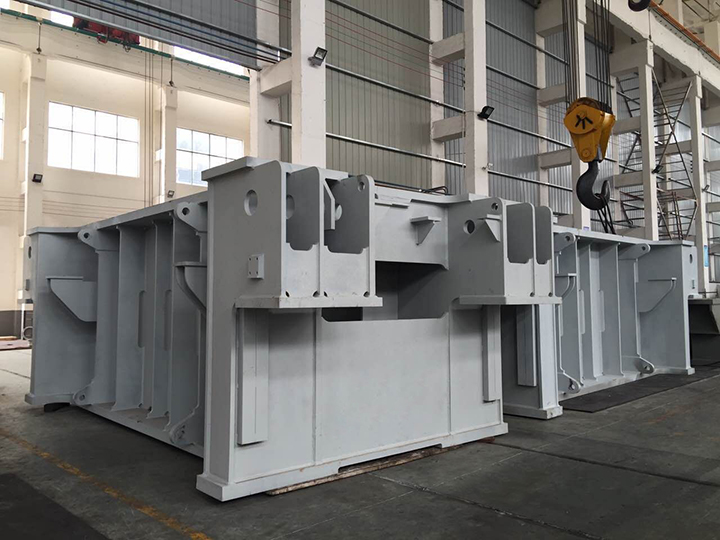
Manufacturing CNC Machined Parts
This guide works through material grades, realistic tolerance bands and inspection methods, based on the process range used by Changzhou Yuqing Heavy Industry Machinery Co., Ltd. (Yuqing Heavy Machinery), a machining and fabrication plant in Changzhou, Jiangsu, China.
What Counts as a CNC Machined Metal Part
A CNC machined metal part is produced by subtractive manufacturing — material is removed from a solid workpiece by computer-controlled milling, turning, drilling, boring or grinding. The process suits parts that need tight tolerances, good surface finish, and consistent geometry across a production run.
Typical characteristics:
• Tolerances from ±0.005mm on precision work, with special setups reaching ±0.001in (0.025mm) or finer on complex geometry
• Repeatability that holds across batches, unlike manual machining
• Freedom to cut undercuts, deep cavities and non-standard contours
• Applicability to almost any machinable metal
Material Selection: Match the Grade to the Service Condition
Reading the Service Condition
The right question is not "what is cheap" but "what does the part have to survive" — high temperature, high pressure, fatigue cycling, corrosion, or weight limits.
|
Category |
Grades |
Where they are used |
|
Carbon steel |
Q235, 45# |
General structural parts, brackets, shafts |
|
Stainless steel |
201, 304, 316, 316L |
Corrosion resistance, food and chemical equipment |
|
Aluminium alloy |
6061, 6063, 7075 |
Lightweight structural parts, housings |
|
Magnesium alloy |
AZ31B |
Weight-critical new energy and aerospace parts |
|
Copper alloys |
Copper, brass, bronze |
Conductivity and thermal conductivity parts |
|
Alloy and special steel |
40Cr, Cr12MoV, titanium alloy, high-temperature alloy |
High pressure, high temperature, heavy load |
|
Engineering plastics |
POM, PTFE, nylon, PEEK, acrylic, bakelite |
Insulating, wear-resistant, low-friction parts |
Two notes worth keeping in mind. First, 316L machines more slowly than 304 and work-hardens if the feed is too light, so the same part in 316L can cost 20–40% more in cycle time. Second, 7075 aluminium machines cleanly but is not weldable in most cases, so a design that welds a bracket after machining needs 6061 instead.
Tolerances: What Is Realistic, and What Is Not
Where the Cost Jumps
Tolerance drives cost non-linearly. The jump from ±0.1mm to ±0.05mm is modest; the jump from ±0.05mm to ±0.01mm can double the operation because it forces slower feeds, more setups and more inspection.
|
Tolerance band |
Typical method |
Notes |
|
±0.2 to ±0.5mm |
Standard milling and turning |
Fine for weldments and brackets |
|
±0.05 to ±0.1mm |
Standard CNC with good fixturing |
Most common commercial band |
|
±0.01 to ±0.02mm |
Precision CNC, controlled temperature |
Requires stable setup and sharp tooling |
|
±0.005mm and finer |
Precision machining, grinding, lapping |
For mating and locating features only |
A practical rule: apply a tight tolerance only to the features that need it — locating bores, mating faces, seal seats — and leave everything else at general tolerance. That single discipline usually saves more money than any negotiation on hourly rate.
Machining Processes in the Range
Composite work is where the savings often appear. Turn-mill composite and five-axis linkage machining complete multiple operations in one setup, which removes the re-clamping error that otherwise accumulates across four separate fixtures.
Heat Treatment and Stress
Metal parts move when you cut them, because removing material releases internal stress. On parts with a large material removal ratio, or on parts that were forged or cast, stress relief before finish machining is what keeps the part flat after it leaves the machine.
Sequence it as: rough machine, stress relieve, semi-finish, heat treat if the drawing calls for it, then finish machine the critical features. Skipping the middle steps is the most common reason a part measures correctly at the shop and moves out of tolerance after a week on site.
Inspection: What Should Arrive With the Parts
Reading an Inspection Report
The inspection report tells you whether the tolerance you paid for was actually held. A complete package for CNC machined metal parts normally includes:
• Full-dimension CMM report for critical features
• Surface roughness measurement
• Hardness testing, Rockwell or Brinell, where heat treatment applies
• Metallographic analysis for critical or safety-related parts
• Non-destructive testing — UT, RT or MT — for welds and castings
Yuqing works to ISO GPS geometric tolerance standards and can match ASME Y14.5, DIN or JIS depending on the destination market, with quality systems aligned to ISO 9001, TS 16949 and AS9100 requirements.
Industries and Applications
Machined metal components from this process range show up across:
• Automotive — engine components, chassis structural parts, transmission parts, EV battery brackets
• Aerospace — engine components, structural parts, fasteners
• Electronics — precision connectors, semiconductor equipment parts, communication equipment
• Construction machinery — excavator, loader and crane structural and hydraulic parts
• Medical equipment — surgical instrument parts, instrument housings
• New energy — photovoltaic accessories, wind gearbox components, energy storage structures
Getting a Quotation That Sticks
Send three things with your enquiry and the quote you receive will be accurate rather than optimistic: the 3D or 2D drawing in a native format, the material and any heat treatment requirement, and the quantity including whether it is a one-off or a repeat programme.
Yuqing accepts CAD, SolidWorks, UG and Pro/E files, offers process optimisation suggestions during drawing review, and handles export packing — vacuum, foam protection and wooden pallets — for sea, air or land shipment.
Changzhou Yuqing Heavy Industry Machinery Co., Ltd. has operated since 1989 from a 10,000m² plant in Changzhou with more than 70 staff and over 30 production machines. Contact the team at sales@czyqzg.com or +86 13906152937 with your drawing set.