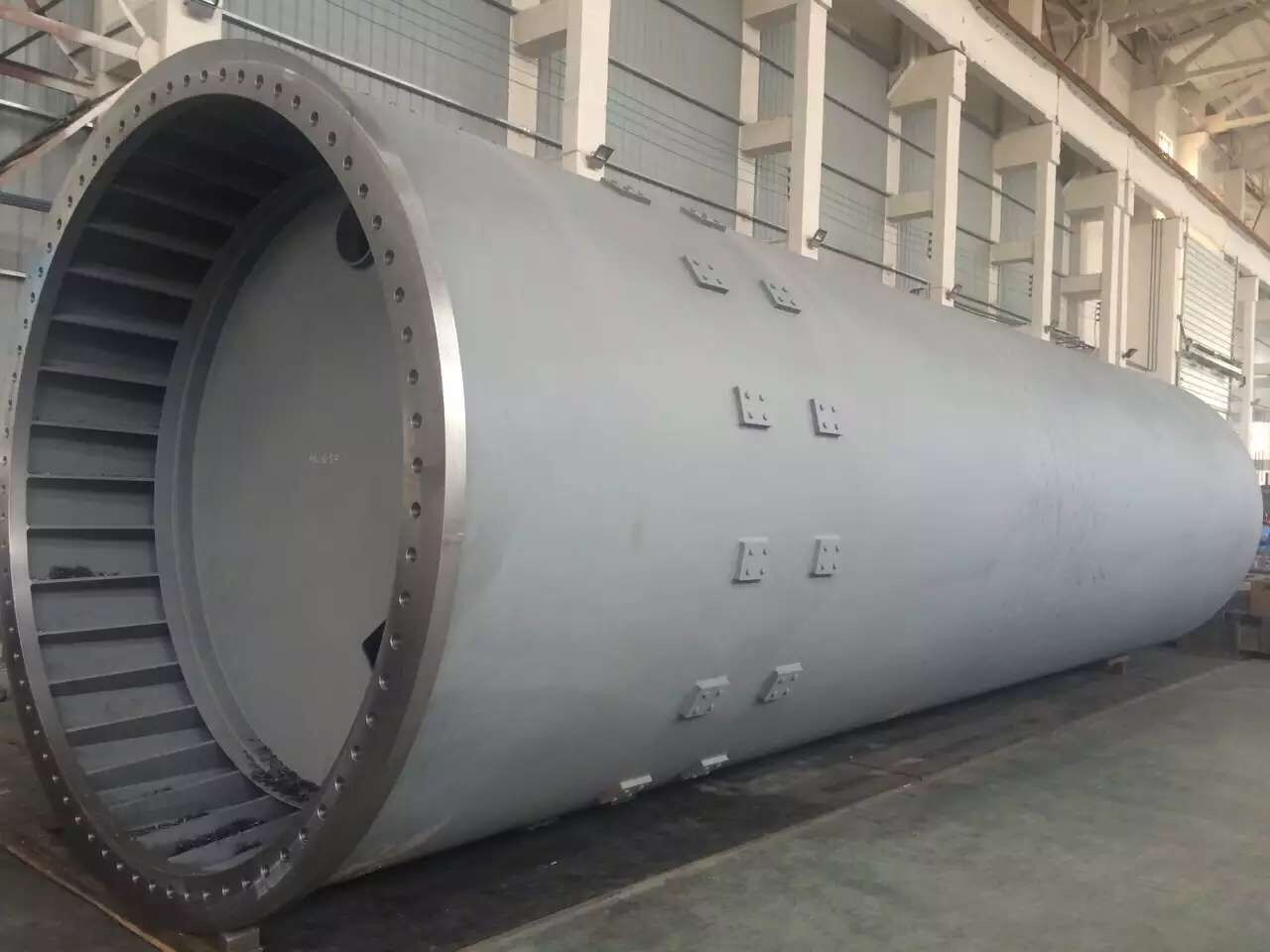
Milling a 300mm plate is a solved problem. Milling a 6-metre frame with a 200mm bore through it is a different discipline, because the machine, the fixture, the part and the workshop all move during the cut.
This guide covers what
CNC milling services for large parts have to handle that standard milling does not, using the machine set and process practice of Changzhou Yuqing Heavy Industry Machinery Co., Ltd. (Yuqing Heavy Machinery), a heavy machining plant in Changzhou, Jiangsu, China.
The Envelope Question Comes First
Before anything else, the job has to fit. Large part milling is defined by three dimensions and one weight, and all four must be confirmed in writing.
Yuqing's largest gantry machining centre is a Jinan Second Machine Tool unit with a 6000 × 13000mm table and 3000mm height. It is a heavy-duty fixed-beam design built for long stroke, high load and high rigidity, and it handles large heavy structural components in energy, engineering machinery, shipbuilding and rail transit. One clamping completes boring, milling, drilling and tapping.
The same shop runs a Suzhou Neway PM254 CNC gantry machining centre and a Shenyang Zhongjie gantry boring and milling centre, plus floor-type machines for work that is too tall for a gantry, and a 5-metre vertical lathe for large rotational parts.
|
Machine type |
Strength |
Typical large-part work |
|
Fixed-beam gantry, 6000 × 13000 × 3000mm |
Long travel, heavy load |
Frames, boxes, wind turbine flanges, vessel heads |
|
Gantry machining centre (PM254 class) |
Rigidity on medium-large parts |
Structural components, plates |
|
Gantry boring and milling centre |
Multi-face boring |
Housings, machine bases |
|
Floor-type milling and boring |
Height and reach |
Tall castings, deep bores |
|
Vertical lathe, 5m |
Rotational symmetry |
Rings, discs, flanges |
Rigidity: Why the Casting Matters
On a 13-metre machine, rigidity is not a specification — it is the reason the tolerance holds. The bed and column on the Jinan gantry are HT300 integral castings, given dual ageing treatment to eliminate internal stress. That stress relief is what prevents a long machine from slowly deforming over years of heavy cutting.
On the floor-type machines, the sliding pillow has a 450 × 450mm cross-section to resist torsion, and the boring bar is a solid alloy component that is dynamically balanced during assembly so it can run at speed without vibration. The spindle itself is forged alloy steel, carburised, quenched and precision ground, on imported roller bearings assembled by constant-temperature cold fitting, giving radial runout under 0.003mm and axial displacement under 0.002mm.
Workholding and Loading
Three Problems That Recur
Large parts frequently cannot be lifted by hand, and often cannot be clamped the way a small part can. Three problems recur.
No flat reference face. A raw casting or weldment may only touch the table at three points. The answer is a fabricated fixture that establishes a stable three-point location before any cut is taken.
Clamping distortion. A thin-wall weldment will deflect under clamp pressure and spring back when released, so the measured part and the released part are different parts. Light, distributed clamping and machined clamping pads solve this.
Part movement during machining. Heavy parts can shift if the support is inadequate, especially when a large amount of material is removed and the weight distribution changes mid-cycle.
Planning the fixture during drawing review — rather than after the first cut — is the standard way to avoid all three.
Thermal Drift on a Large Envelope
Why One Degree Matters Across Six Metres
The larger the part, the more the part's own temperature matters.
Steel expands by roughly 12 × 10⁻⁶ per °C, which means a 6-metre part grows about 0.07mm for every 1°C of temperature rise. On a bore tolerance of ±0.05mm, a warm afternoon is enough to consume the entire allowance.
Three countermeasures are standard in heavy milling:
• Thermal growth compensation built into the CNC, modelling spindle and axis growth
• Backlash compensation, which matters more as travel length increases
• 3D volumetric compensation, correcting the machine's error across the whole working volume rather than along single axes
Because the workpiece itself expands too, the measurement plan has to state the temperature at which dimensions are reported. On large parts, a dimension without a temperature is an incomplete specification.
In-Process Measurement
On large parts you cannot carry the workpiece to the inspection room, so the measurement has to happen at the machine.
In-process measurement integrated with the CNC control detects tool wear, part orientation and dimensional accuracy while the part is still clamped. Combined with 2D and 3D laser measurement systems and coordinate measuring machines for final verification, this is what prevents the most expensive failure mode in heavy milling: discovering a 0.15mm error after the part has been unclamped, lifted and transported.
The practical sequence is to measure after roughing, re-datum if needed, then finish with the knowledge that the remaining stock is where it should be.
Milling Capability and Materials
On the Φ160 floor-type machine, milling supports surface milling, contour milling and cavity milling with carbide tooling, and covers Q235 carbon steel, 45# steel, stainless steel, cast iron and alloy steel. Milling efficiency is quoted at roughly 30% higher than a conventional boring machine on comparable work, which comes from the combination of gantry-class rigidity and a 37/45kW spindle motor.
Boring on the same machine handles diameters from 20mm to 500mm, with deep hole boring to 2000mm depth. That combination — large bores, deep holes and long milling passes on one machine — is what removes the multi-setup error that accumulates when the job is split across smaller machines.
When to Choose Gantry and When to Choose Floor-Type
Matching the Machine to the Geometry
The choice is not about size alone.
Gantry machines suit wide, flat or box-shaped work where the part sits on the table and the spindle travels over it — frames, plates, bases, flanges, vessel heads. The fixed beam gives high rigidity across a long travel.
Floor-type machines suit tall work and work that needs a long boring stroke into a horizontal face, where the column travels along the floor and the spindle reaches into the part. Deep hole boring on a large housing is floor-type work, not gantry work.
A supplier with both types can take the job on the right machine rather than forcing it onto the nearest available one — and that decision usually shows up as a difference in both cost and tolerance.
Sending a Large Part for Quotation
When you request
CNC milling services for large parts, include the maximum envelope dimensions and weight, the material and heat treatment, the tolerance and surface finish on each critical feature, the inspection report format you need, and the lifting and transport constraints at your end.
Yuqing accepts CAD, SolidWorks, UG and Pro/E drawings, runs UT, RT and MT inspection in-house, and handles export packing with vacuum protection, foam and wooden pallets.
Changzhou Yuqing Heavy Industry Machinery Co., Ltd. has operated since 1989 from a 10,000m² plant in Xueyanqiao Town, Wujin District, Changzhou, with more than 70 staff and over 30 machines, and holds ISO certification and national high-tech enterprise status. Contact sales@czyqzg.com or +86 13906152937.