When
custom cnc machining parts made to your drawing arrive correct, the reason is usually not luck. It is that eight stages were each completed properly, in the right order, and each one was verified before the next began.
This article walks through those stages as they run at Changzhou Yuqing Heavy Industry Machinery Co., Ltd. (Yuqing Heavy Machinery), a machining and casting plant in Xueyanqiao Town, Wujin District, Changzhou, Jiangsu, China.
Stage 1 — Enquiry and Drawing Review
Everything starts with the drawing. The supplier checks that the geometry is manufacturable, that the tolerances are achievable, and that the material suits both the application and the machining process.
Yuqing accepts 3D and 2D files in CAD, SolidWorks, UG and Pro/E formats. During review, the engineering team can propose process optimisation — a different datum, a relaxed non-critical tolerance, a radius that lets a standard tool reach the floor of a pocket. Suggestions at this stage cost nothing; the same changes after machining cost a new part.
Stage 2 — Material Selection and Stock Preparation
Matching Grade to Service Condition
The material is chosen against the service condition rather than the price list.
Carbon steels such as Q235 and 45# cover general structural parts. Stainless grades 201, 304, 316 and 316L handle corrosion. Aluminium alloys 6061, 6063 and 7075 and magnesium AZ31B serve lightweight applications. Copper, brass and bronze cover conductivity. Alloy and special steels including 40Cr, Cr12MoV, titanium and high-temperature alloys handle high pressure, high temperature and heavy load. Engineering plastics — POM, PTFE, nylon, PEEK, acrylic and bakelite — are used for insulation, wear resistance and low friction.
Stock is cut to size with allowance for clamping and for the machining sequence. On parts with a high removal ratio, that allowance is generous in the roughing stage and minimal in the finishing stage.
Stage 3 — Process Planning and Sequencing
The route is fixed before programming: which operations, on which machine, in which order, and where heat treatment sits.
A typical route for a machined and heat-treated part:
1. Cut stock
2. Rough machine
3. Stress relief or heat treatment
4. Semi-finish, re-datum from a machined face
5. Finish machine critical features
6. Deburr and surface treat
7. Final inspect and pack
Getting the position of step 3 right is what keeps the finished part straight. Heat treatment after finishing will move the part; heat treatment before roughing leaves too much material to remove accurately.
Stage 4 — CAM Programming and Fixture Design
The model becomes toolpaths — cutting speeds, feeds, depths of cut, entry strategies and tool selection. This is also where the fixture is designed, because the fixture determines whether the toolpath can be executed accurately.
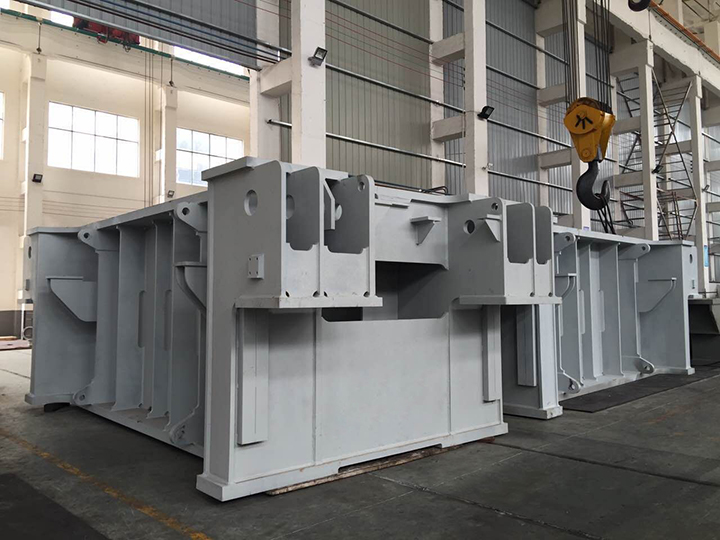
On simple parts a vice or standard chuck is enough. On parts with thin walls, irregular surfaces or no natural clamping face, a dedicated fixture is built. On the largest work, the fixture may be fabricated from weldments and machined in place to establish a datum.
Stage 5 — Machining
Capability by Operation
Custom part manufacturing at Yuqing covers CNC turning, CNC milling, CNC drilling and boring, and CNC engraving and milling, with tolerances controlled within ±0.005mm. Conventional processes — turning, milling, planing, grinding, drilling, reaming and tapping — handle the simpler features, and composite work such as turn-mill and five-axis linkage completes multiple operations in one setup.
|
Operation |
Machine type |
Typical tolerance |
|
CNC turning |
Turning centre / lathe |
±0.005mm |
|
CNC milling, 3 to 5-axis |
Machining centre, gantry |
±0.005mm on precision work |
|
CNC drilling and boring |
Boring mill, gantry |
Bores 20–500mm, deep holes to 2000mm |
|
Engraving and milling |
High-speed mill |
Fine detail, shallow profiles |
|
Grinding |
Surface and cylindrical grinders |
Flatness and finish after heat treatment |
One clamping completing boring, milling, drilling and tapping is the goal on larger parts, because it eliminates the repositioning error that builds up when a part is moved between machines.
Stage 6 — In-Process Inspection
Inspection during the run catches drift while it is still correctable. Tool wear monitoring, scheduled dimensional checks and operator inspection at defined stages all contribute, and on critical parts the measurement is integrated with the CNC control so the part is checked without being unclamped.
This matters most on large and complex parts, where the cost of finding an error late is measured in days rather than minutes.
Stage 7 — Post-Processing
After machining, parts move into finishing: deburring, surface grinding, polishing, and surface treatment. The options at Yuqing include electroplating in zinc, chrome and nickel, anodising, passivation, painting and hot-dip galvanising, alongside precision forging and sheet metal bending for parts that need forming.
Where a part is welded, the weld is inspected before coating rather than after. UT, RT and MT inspection on the finished surface is difficult once paint is applied, and a defect under paint is a defect you cannot see.
Stage 8 — Final Inspection and Packing
Reports and Export Packing
Final inspection produces the documentation that travels with the order: full-dimension CMM results with measured values, roughness measurements, hardness testing to Rockwell or Brinell, metallographic analysis and non-destructive testing reports. Yuqing works to ISO GPS geometric tolerance standards and can align to ASME Y14.5, DIN or JIS depending on the destination market, with quality systems following ISO 9001, TS 16949 and AS9100 requirements.
Export packing uses vacuum packaging, foam protection and wooden pallets for sea, air and land transport, meeting international logistics standards. Marking and traceability are applied at this stage so the parts can be identified on arrival.
What Makes the Difference Between Two Identical Quotes
Given the same drawing and the same price, the difference between a good and a poor outcome comes down to four things:
• Whether the drawing was genuinely reviewed, and the problems raised early
• Whether the process sequence put heat treatment in the right place
• Whether in-process inspection caught drift, or final inspection caught a scrap part
• Whether the packing was designed for the weight and the transport mode
All four are process decisions, not equipment decisions — and they are what turn a drawing into custom CNC machining parts made to specification.
About Yuqing Heavy Machinery
Changzhou Yuqing Heavy Industry Machinery Co., Ltd. has been machining and casting since 1989. The facility in Changzhou covers 10,000m², employs more than 70 people and runs over 30 pieces of equipment, from gantry machining centres with a 6000 × 13000mm table to Φ160 and Φ200 floor-type boring and milling machines and a 5-metre vertical lathe. The company holds ISO certification and was recognised as a national high-tech enterprise in 2025, and serves customers in China as well as the United States, Japan, South Korea, India, Thailand, Finland and Germany.
To start a made-to-drawing CNC part, send your files to sales@czyqzg.com or call +86 13906152937.