What Is Large-Part Machining?
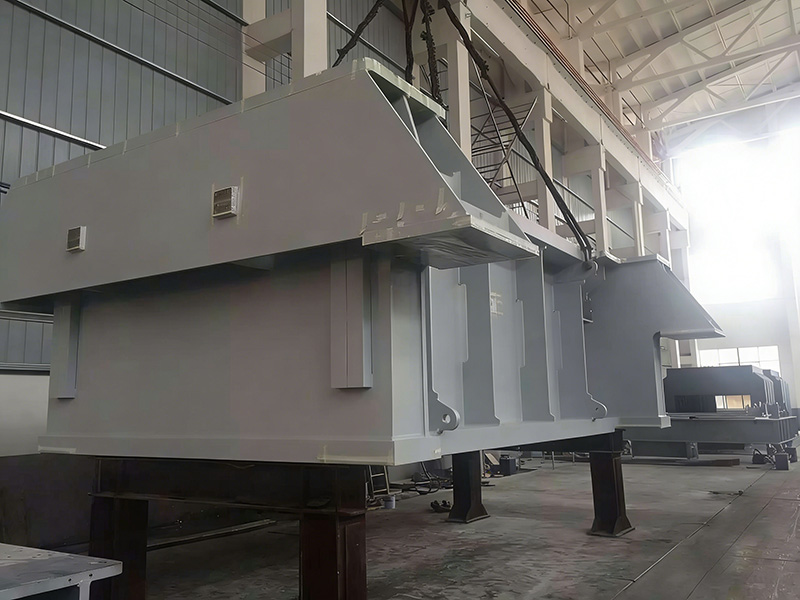
Large-part machining refers to the machining of parts that exceed the envelope of a standard vertical machining center (VMC), typically parts larger than 1 m in any single dimension or heavier than 1–2 tonnes. Examples include:
Machine tool bases and columns
Gearbox housings
Turbine casings
Press frames
Large structural weldments
Marine and power-generation components
These parts require machines with larger work envelopes, higher torque spindles, more rigid construction, and rotary tables or attachments that support the part weight and size.
Yuqing's floor-type boring and milling machine capability is designed specifically for these parts.
Why Use Floor-Type Boring and Milling Machines?
Floor-type boring and milling machines (also called horizontal boring machines, floor mills, or table-type boring mills) are designed for large parts. The advantages over standard VMCs:
Larger work envelope: floor-type machines typically support parts 2 m × 2 m × 1.5 m or larger.
Higher torque spindles: the spindles deliver higher torque at lower speeds, which is required for heavy material removal on large parts.
Rigid construction: the machine frame, column, and spindle are designed for the higher cutting forces of large-part machining.
Rotary tables: the machines can be equipped with large rotary tables (up to several meters in diameter) that handle heavy parts and allow 4-axis machining.
Longer tool reach: the spindle can reach features deep inside large parts without repositioning the part.
Head attachments: the spindle can be fitted with right-angle heads, universal heads, or extended heads for compound-angle machining.
The cost is higher machine investment and larger floor space. The economic case is justified when the part requires the larger envelope or the higher rigidity.
What Are the Common Floor-Type Configurations?
|
Configuration |
Work Envelope |
Best For |
|
Table-type horizontal boring |
2 m × 2 m × 1.5 m |
Large prismatic parts, weldments |
|
Floor-type horizontal boring |
3 m × 3 m × 2 m |
Very large parts, single-piece production |
|
Gantry-type boring/milling |
5 m × 3 m × 2 m |
Long parts, plates, large weldments |
|
Moving-column boring |
4 m × 2 m × 1.5 m |
Parts longer than the table |
|
Cross-beam floor-type |
3 m × 2 m × 2 m |
Tall parts |
The choice depends on the part dimensions, the weight, and the feature access. For very long parts, a gantry-type or moving-column machine is best. For tall parts, a cross-beam machine is best.
Yuqing's processing of various structural parts capability covers a wide range of large structural parts using these configurations.
How Are Large Parts Fixtured?
Large parts are fixtured differently than small parts. The challenges:
Weight: the part may weigh several tonnes, requiring crane handling.
Size: the part is larger than the machine table, requiring external support.
Stability: the part must be stable throughout machining, including during heavy cuts.
Access: the fixture must not obstruct the cutting tool.
Common fixturing approaches for large parts:
Direct clamping to the table: the part is bolted directly to the machine table with T-bolts or fixture clamps.
Sub-plate: the part is bolted to a sub-plate, which is then clamped to the table. The sub-plate is pre-prepared with clamps and locating pins for repeatable setup.
Rotary table: the part is clamped to a rotary table, which provides 4-axis indexing.
Angle plate or tombstone: the part is clamped to a vertical angle plate for machining features on the side.
Custom fixture: a dedicated fixture is built for the part, with locating features and clamps.
The fixture is designed to support the part throughout the machining, not just at the start. As material is removed, the part's center of gravity may shift, and the fixture must compensate.
How Are Large Parts Sequenced?
The operation sequence for a large part is critical. The sequence is typically:
Rough machining: remove the bulk of the material with heavy cuts at low spindle speed. The goal is to bring the part close to the final shape quickly.
Stress relief: if the part has been welded or has high residual stress from previous operations, stress relief (thermal or vibration) may be required before finish machining.
Semi-finish machining: machine the features to within 0.1–0.5 mm of the final dimension.
Finish machining: machine the features to the final tolerance and surface finish.
The sequence minimizes the time spent on finish cuts (which are slow) and maximizes the time spent on rough cuts (which are fast). It also minimizes the risk of distortion by removing stress gradually.
For welded parts, the sequence may include welding, stress relief, and then machining. The welding and machining steps are coordinated to minimize distortion.
How Is Large-Part Tooling Different?
Tooling for large-part machining differs from tooling for small-part machining:
Long-reach tools: tools may extend 200–500 mm from the spindle to reach deep features. Long-reach tools are more prone to deflection, so they are used with reduced step-over and slower cutting parameters.
High-torque tooling: tools must withstand the higher cutting forces of heavy material removal. Coated carbide tools are standard.
Modular tooling: many large-part tools use modular systems (e.g., Capto, HSK) to allow quick changes between roughing and finishing heads.
Specialty heads: right-angle heads, universal heads, and extended heads are used to reach features that the standard spindle cannot reach.
Indexable heads: for facing large surfaces, indexable milling heads with multiple inserts are used to spread the cutting force across multiple edges.
The tool selection is a balance between reach, rigidity, and cost. Long-reach tools are expensive and prone to deflection; they are used only when necessary.
How Are Large Parts Inspected?
Large parts are inspected with portable equipment:
Portable CMM: a portable CMM with a measuring arm or laser tracker can be brought to the part on the machine table.
Laser tracker: a laser tracker measures large distances accurately and is used for part alignment and large-feature inspection.
Precision levels and squares: traditional tools for checking flatness, squareness, and parallelism on large surfaces.
Height gauges and long-blade calipers: for measuring dimensions that exceed the range of standard calipers.
Optical comparators: for measuring features that can be brought to the comparator.
The inspection approach depends on the tolerance required. For tight tolerances (e.g., ±0.025 mm on a critical feature), a portable CMM is required. For looser tolerances, traditional tools are sufficient.
What Are the Common Defects in Large-Part Machining?
Common defects in large-part machining:
|
Defect |
Cause |
Prevention |
|
Distortion after machining |
Residual stress, weld stress, uneven material removal |
Stress relief before finish machining, balanced machining |
|
Out-of-tolerance features |
Thermal expansion during machining |
Allow machine to warm up, measure at reference temperature |
|
Chatter marks on surface |
Insufficient rigidity, long tool, wrong cutting parameters |
Use shorter tools, reduce step-over, lower cutting forces |
|
Tool deflection on long tools |
Tool overhang exceeds rigid limit |
Reduce tool overhang, use carbide tools, lower cutting forces |
|
Inaccurate fixture location |
Worn locating pins, loose clamps |
Inspect fixture before each run |
|
Welded part distortion |
Welding heat input |
Balance weld sequence, use restraint fixtures
|
Each defect is preventable with discipline. For one-off or low-volume large parts, the first-article inspection is critical to identify issues before they are repeated across the lot.
How Is Large-Part Machining Quoted?
Large-part machining is quoted using the time-driven cost model:
Machine time: the machine hourly rate for the floor-type boring machine is typically 2–5× the rate of a standard VMC.
Setup time: the setup for a large part is typically 2–8 hours, including crane handling and fixture installation.
Tooling cost: the tooling cost is higher than for small parts, due to long-reach tools and specialty heads.
Inspection cost: portable inspection equipment is expensive; the cost is amortized over the inspection time.
Crane handling: the part may require multiple crane lifts; the cost of crane time is included.
For a large part, the quote should itemize the cost components so the customer understands the breakdown. The most variable cost is the cycle time, which depends on the cutting parameters, the tool selection, and the operator skill.
What Is the Future of Large-Part Machining?
Trends in large-part machining:
Larger machines: builders are introducing machines with even larger envelopes to handle larger parts (e.g., wind turbine components).
Higher torque spindles: direct-drive spindles with higher torque at lower speeds for heavy cutting.
Automation: robotic loading and unloading of large parts, reducing crane time and operator risk.
Hybrid additive-subtractive: large-format additive manufacturing combined with machining for near-net-shape parts.
Improved CAM software: better toolpath generation for large parts, including optimization for thermal management.
For a custom machine shop, the trend toward larger and more capable machines means that more parts can be machined in one setup, reducing cost and lead time.
Conclusion
Large-part machining requires floor-type boring and milling machines with larger envelopes, higher torque, and robust fixturing. The strategy is to select the right machine configuration, plan the fixturing for the part weight and size, sequence the operations to maintain stability, and inspect with portable equipment. Yuqing's floor-type boring and milling machine capability, processing of various structural parts, equipment, and workshop resources support large-part machining for a wide range of industries.
Frequently Asked Questions
What is the largest part that can be machined on a floor-type boring machine?
It depends on the machine, but floor-type boring machines can handle parts up to several meters in each dimension and up to 20 tonnes or more in weight. Gantry-type machines can handle even larger parts.
How is distortion controlled during large-part machining?
Distortion is controlled by stress relief before finish machining, balanced material removal, and sequencing the operations to minimize uneven cutting forces.
What is the typical tolerance for large-part machining?
Typical tolerances are IT8–IT10 for large parts. Tighter tolerances (IT7) require special fixturing and may require multiple setups.
How long does it take to machine a large part?
A large part can take anywhere from a few hours to several weeks, depending on the size, the material, and the feature complexity. Roughing is fast; finishing is slow.
What is the cost of floor-type boring machine time?
Floor-type boring machine time is typically 2–5× the cost of standard VMC time, due to the higher machine investment and the larger footprint.
How are large parts transported to and from the machine?
Large parts are transported by overhead crane within the shop and by truck or rail for delivery. The shop must have adequate crane capacity for the heaviest part it can machine.
Can large parts be machined in one setup?
For many large parts, one setup is sufficient. For very large parts, multiple setups may be required to reach all features. Multi-axis capability reduces the number of setups.
How are large parts aligned on the machine table?
Large parts are aligned using laser alignment, precision levels, or the machine's probing system. The alignment is critical for accurate machining.
What is the typical fixturing cost for a large part?
Fixturing cost for a large part ranges from a few hundred dollars for direct clamping to several thousand dollars for a custom fixture. The cost is amortized over the lot size.
How are large parts inspected?
Large parts are inspected with portable CMMs, laser trackers, precision levels, and traditional tools. The inspection equipment must be capable of reaching the part on the machine table.
What materials can be machined on a floor-type boring machine?
Most engineering materials can be machined: carbon steel, alloy steel, stainless steel, cast iron, aluminum, and some engineering plastics. Hardened materials require specialty tooling.
What is the difference between a floor-type and a table-type boring machine?
A floor-type boring machine has the workpiece on the floor; the spindle moves over the part. A table-type boring machine has the workpiece on a moving table. Floor-type machines handle larger parts.