Welding joins metal. It does not, on its own, produce a part that fits. That is why welded parts almost always need a machining step afterwards — and why the shops that can weld and machine under one roof deliver weldments that bolt straight into place.
This article covers the full chain for welded components: process selection, weld quality control, post-weld machining, and the tolerances you can realistically hold. Practice data comes from Changzhou Yuqing Heavy Industry Machinery Co., Ltd. (Yuqing Heavy Machinery), which has run welding and machining together in Changzhou, Jiangsu, China since 1989.
Three Categories of Welded Work
Not all
welded parts are the same job, and the equipment and inspection level change with the category.
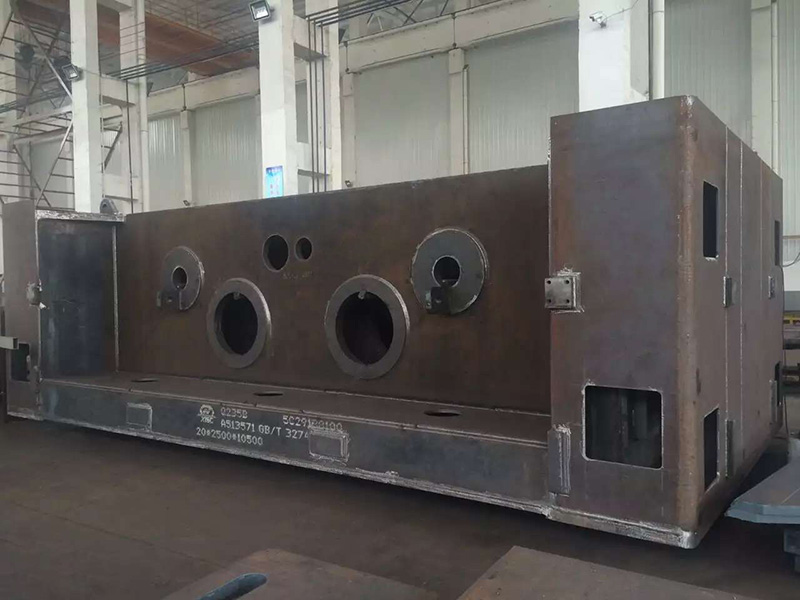
Welded parts fabrication in the welding workshop
General structural welding covers frames, bases and enclosures where the weld carries load but the geometry is not critical. Inspection is usually visual plus dimensional.
Precision component welding covers parts where weld distortion will affect a machined feature — motor mounts, machine tool structures, alignment frames. These need sequence control and usually post-weld machining.
Heavy-duty component welding covers thick-section work: excavator bases, ship fittings, press frames, energy equipment. These need preheat, controlled interpass temperature and full NDT.
Welding Processes in the Range
Arc, TIG and Laser
Yuqing's
welding workshop runs arc welding, argon arc (TIG) welding and laser welding, which between them cover the common production cases.
|
Process |
Best suited to |
Notes |
|
Arc welding (MMA / MIG / MAG) |
Carbon and low-alloy steel, thick sections |
Highest deposition rate, most economical |
|
Argon arc (TIG) welding |
Stainless steel, aluminium, thin sections, root passes |
Cleanest arc, best for appearance and root quality |
|
Laser welding |
Thin sheet, precision assemblies, low distortion |
Narrow heat-affected zone, minimal distortion |
The full production route covers plate cutting, bending, welding, flaw detection and surface treatment, so a welded frame arrives as a finished component rather than a sub-assembly needing three more vendors.
Material Selection for Weldments
Weldability, not strength alone, decides which material is practical.
• Carbon steel — easiest to weld, lowest cost, used for the majority of structural weldments
• Stainless steel — weldable with TIG and the right filler, but distortion is higher because of thermal expansion; 304 and 316/316L cover most cases
• Aluminium alloy — light and corrosion resistant, but needs TIG with correct filler and higher heat input; 6061 is common, 7075 generally is not welded
• Alloy steel — used for higher strength and wear resistance, and usually requires preheat and post-weld heat treatment
Choosing a weldable grade early is cheaper than discovering at the welding stage that the material specified for its mechanical properties cannot be joined reliably.
Weld Quality and Inspection
What UT, MT and RT Detect
A weld that looks sound can still contain porosity or lack of fusion, so critical joints are tested rather than judged by eye.
The standard methods:
• UT (ultrasonic testing) — detects internal defects in full-penetration welds, effective on thick sections
• MT (magnetic particle testing) — detects surface and near-surface cracks in ferromagnetic material
• RT (radiographic testing) — produces a permanent image of internal quality, often required for pressure and safety-related work
• Visual and dimensional inspection — the first line, and still the cheapest defect filter
At Yuqing, key welds undergo UT and MT inspection and are required to be free of porosity and cracks and to meet the strength standard of the base metal. On a typical structural weldment this means the joint is not weaker than the plate it joins — which is the point of welding in the first place.
Post-Weld Machining: Where the Tolerance Comes From
The Six-Step Correction Route
Welding distorts. Thermal contraction pulls a frame out of square, bows a long base, and moves a bore off position. Post-weld machining is the correction, and it is the step that decides whether the part can be assembled.
Weldment machining refines dimensions, surface finishes and critical features after welding is complete. The sequence normally runs:
1. Weld and allow controlled cooling
2. Stress relief where the drawing or the material requires it
3. Rough machine to remove distortion
4. Semi-finish and re-datum from a machined face
5. Finish machine bores, mating faces and locating features
6. Inspect and record
After
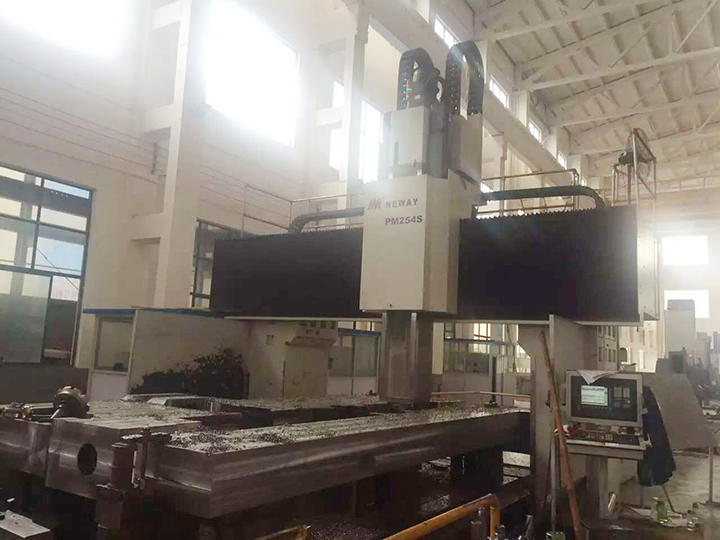
welding and CNC machining correction, Yuqing holds key dimension tolerances of ±0.05 to ±0.2mm on welded parts. That band is realistic for large fabrications: tighter numbers are achievable, but only on specific features with dedicated fixturing, not across a 5-metre frame.
Datum Strategy on Weldments
The single biggest cause of rejected weldments is a datum that moves between operations. If the first operation datums from a raw plate edge and the second from a welded flange, the two operations are not working in the same coordinate system.
The fix is to machine a datum early and use it for everything afterwards — a machined face, a machined bore, or a set of tooling holes. On a part that will be inspected against a drawing, that same datum should be the one reported in the inspection data.
Flexibility: From Trial Order to Production
Welded fabrication suits small batch trial orders as well as stable large-volume supply, and non-standard customisation is normal rather than an exception. The practical constraint is fixturing: a one-off frame needs a fabricated fixture that may cost as much as the welding itself, while a repeat programme amortises it across hundreds of units.
For repeat work, a simple welding jig usually pays for itself within the first few units by removing the fit-up time and the rework.
Applications
Welded components from this capability set are used for:
• Automation equipment racks and machine frames
• Engineering machinery structural components
• New energy equipment frames
• Ship accessories and deck fittings
• Machine tool protective shells and guards
• Bases, boxes and housings for heavy equipment
Working With Yuqing Heavy Machinery
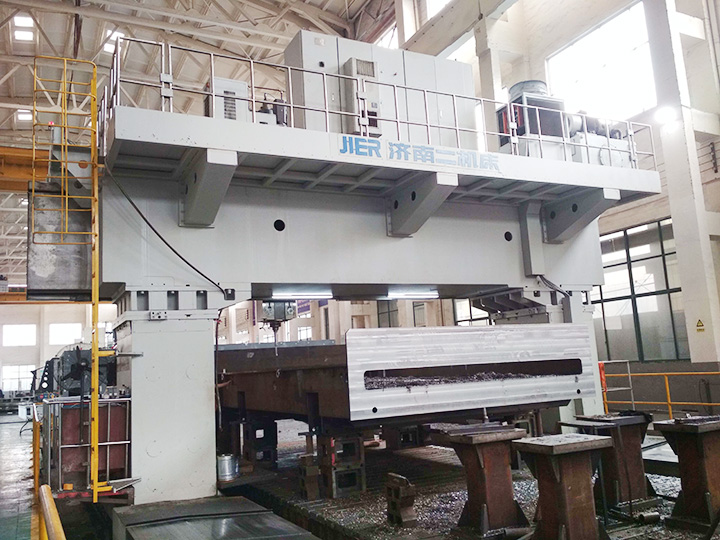
Changzhou Yuqing Heavy Industry Machinery Co., Ltd. has been in machining and casting since 1989. The plant covers 10,000m² in Xueyanqiao Town, Wujin District, Changzhou, Jiangsu, employs more than 70 people and runs over 30 pieces of equipment, including gantry machining centres with a 6000 × 13000mm table and floor-type boring and milling machines in Φ160 and Φ200 spindle sizes.
The company holds ISO certification, was recognised as a national high-tech enterprise in 2025, and serves customers across China as well as in the United States, Japan, South Korea, India, Thailand, Finland and Germany.
Send your weldment drawings, material grade and inspection requirement to sales@czyqzg.com or call +86 13906152937 for a fabrication and machining quotation.